
Dear Chhaharee, Happy Anniversary!
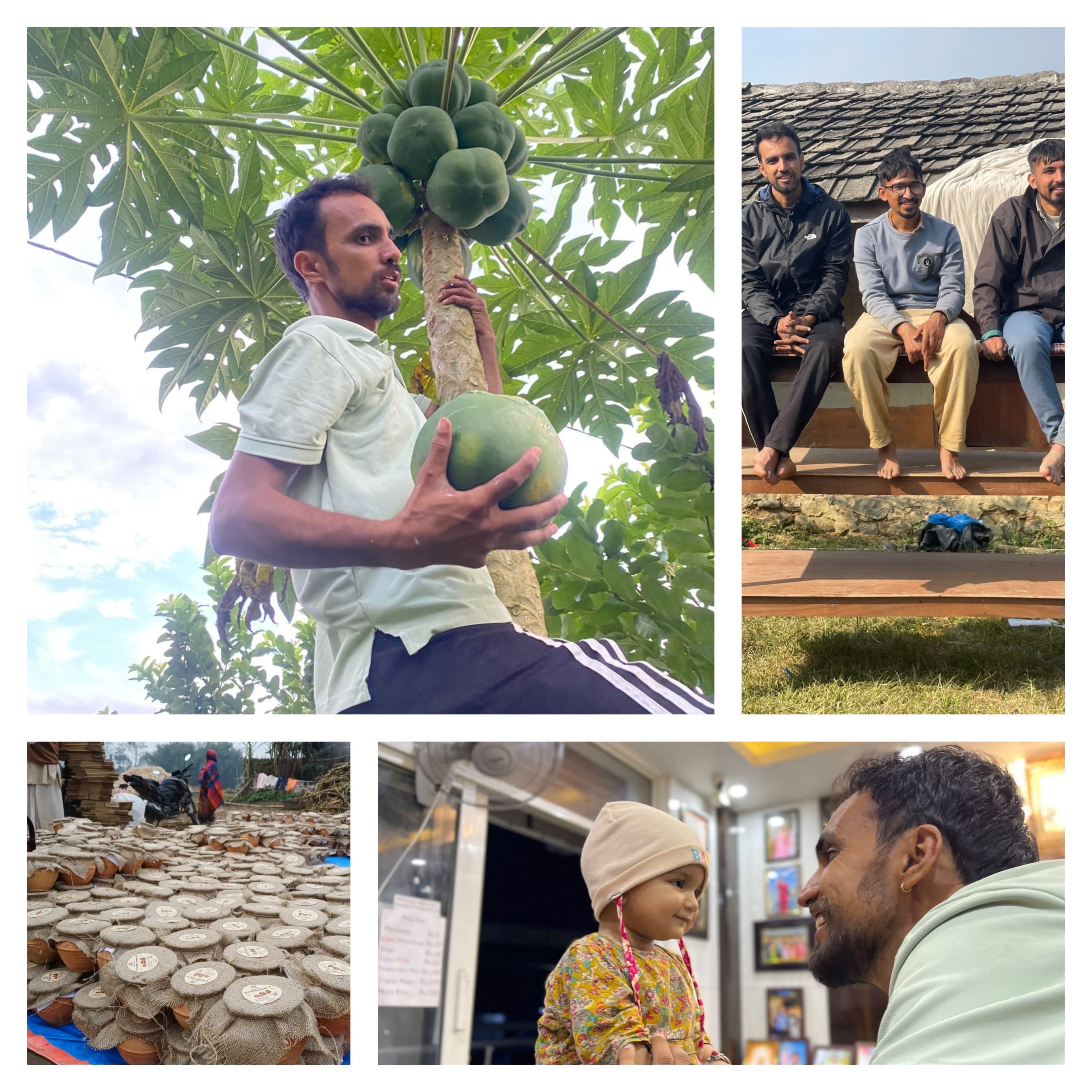
After threshing the rice harvested around Tihar, Chhaharee completed its first annual crop cycle. This year, we harvested approximately 45 muri of rice: 20 muri of winter rice and 25 muri of monsoon rice.
How wonderful! This year, the rice we grew on our own farm is enough to feed both our guests and everyone in the Chhaharee family.
After taking the harvested rice to our rented house for storage, we went to a tea shop. Over a cup of tea, we quietly celebrated not only Chhaharee Farm's first anniversary but also our first year of this journey together.
Although there are eleven of us in the Chhaharee family, only three of us are closely involved in the day-to-day life of the farm: Pradip, Dipesh, and me. Almost without realizing it, we have spent a year at Chhaharee.
A year that has been peaceful, carefree, and full of love.
That does not mean we never got angry or argued. Sometimes faces turned red, and sometimes we spoke our minds. But soon enough, we embraced each other with love and trust. We held each other's hands with confidence and found our way back to the light, even when the evening seemed a little darker.
We have completed one year at Chhaharee.
Happy Anniversary, dear Chhaharee!
One Year Ago
Saroj
One evening, after returning from the office, he took off his black coat and hung it on the wall. The next morning, he woke up and left for Sindhuli.
But in the eyes of society, this was hardly a sensible decision, one that would lead to success or financial prosperity. To many, it was nothing less than madness.
It was not as though he had nothing to hold on to. He had a daughter who was about to turn one. His wife had a reasonably well-running business built through her own efforts. He had some additional income from occasional assignments through an office he already knew. He was also practising law with one of his closest friends.
There was nothing particularly lacking in his life. Nor was there anything he desperately needed.
Making reels was easier in the city. TikTok looked brighter there. Taking his wife and daughter to Phewa Lake was more convenient from the city. His in-laws lived closer, and even travelling to meet his parents was easier from there.
Yet, one morning, he left everything behind and headed for Sindhuli.
Dipesh
A decent job at a prestigious organization. A small farming enterprise near the city, built through his own and his family's efforts. By age, name, and temperament, he was a Gen Z farmer and activist, someone quite active in his field.
He was educated and articulate. His opinions and conversations had earned him recognition in the media. From government ministries to parliamentarians, his name occasionally made its way into public discussions.
Almost everyone around him, his friends and peers, had left the country or boarded flights abroad. In a household where most people wore blue coats and white shirts to work, he too had carried a book of dreams and the ambition of becoming a government officer.
The age for settling down and building a family was gradually approaching.
Yet, he left behind the city, the opportunities, the comforts of life, and even the car parked in his own garage. One morning, Dipesh, the Gen Z farmer, headed for Sindhuli.
Pradip
Following the events of Bhadra 23 and 24, political parties that had long been absorbed in the cycle of power and political privilege were badly shaken and pushed to the margins.
A non-partisan government had just been formed, riding on the flames of Singha Durbar. Those who had long questioned power from the streets were themselves uncertain about what lay ahead.
Even in the discussions Pradip participated in, the imagination of a future society and politics remained blurred.
For a long time, the familiar visits to Maitighar Mandala had stopped. He had been eating food bought with his father's earnings, prepared through his mother's skills and served by his grandmother. He drank tea with money given by his elder brothers and sisters (especially his sisters), rode his motorbike between Bagbazar and home, and enjoyed the comforts of family life.
Yet, deep inside, the discomfort of dependency remained.
What did Marx say? What did Lenin do? What about Stalin or Mao? Surely, there could be no real movement without labour, without becoming part of the production process.
So Pradip once again left the city and its streets for the fields.
Maitighar Mandala, where he once raised slogans, became distant. Bagbazar, where he regularly went for tea and meals, was now far away. Those who dreamed of an alternative world while eating food produced through someone else's labour became strangers.
His beloved remained behind in the glittering lights of the city.
Pradip became a farmer.
Now, let us leave the stories and struggles of these boys aside.
Poison Is Cooking in Our Kitchens
When my daughter was five months old, I started spending most of my time with her. Apart from breastfeeding, I began taking responsibility for almost everything else. Naturally, I became increasingly concerned about what she ate.
I began to understand what my parents must have meant when they used to tell me, when I troubled them as a child, that I would understand everything once I had children of my own.
What does she eat? How does she eat? What kind of food makes her feel healthy and comfortable?
These questions became part of my everyday life.
Having some interest in and knowledge of Nepal's agricultural production system, I was always a little worried whenever I prepared food for my daughter. I could hardly feel confident about the food we consumed, whether it was ready-made food from the market or even meals prepared at home.
How many chemicals might have been used on the potatoes I put into her porridge? What about the lentils and rice? What about the vegetables? What about the milk?
The questions were endless.
I gradually realized that the only way to find some answers was to grow at least some of our own food and take greater responsibility for our kitchen. To reduce our dependence on externally purchased ingredients as much as possible.
Otherwise, poison is cooking in many of our kitchens today. In the name of food, we are consuming something close to poison.
The way out is to produce food ourselves, as much as our capacity allows. If possible, we should grow as many things as we can with our own hands and bring them directly to our kitchens.
And for that, we must return to the soil.
This was the first experience that inspired me to take up farming.
There Is Fear, Too
Farming is joyful. But there is one state of mind that continues to trouble me. It is the financial uncertainty.
What if I or someone in my family faces a health problem tomorrow? What if I cannot afford even the basic education of my only daughter? What if I cannot provide food for my loved ones? What if, because of my choices, my family cannot enjoy the ordinary comforts and opportunities that life could otherwise offer?
These worries continue to haunt me.
What if the confidence that I am doing the right thing begins to fade? What if I start feeling inferior because of my own work? What if difficulties return? What if I become mentally unsettled?
What if one day my father points a finger at my work and says, "Shame on you, son"?
What if the life partner who has always filled my hands with happiness from her own share of life eventually says, "What a miserable life this has become"?
What will I say if my daughter asks me, "Father, why didn't you spend money on me?"
These are some of the possible emotional struggles that come with this journey.
Apart from these worries, farming is incredibly joyful.
I am not just uncertain but almost certain that I may not be able to sustain an increasingly expensive and extravagant lifestyle: a four-anna plot of land, a four-storey house, a four-wheeler, and an ever-growing list of expenses.
However, the idea that farming cannot provide a livelihood or that agriculture has no future has been challenged by my first year's experience.
We can farm without synthetic chemicals and pesticides, without degrading the soil, and without disrupting nature's rhythms. The hope I had a year ago has now turned into confidence.
We can sustain our lives. We can earn a little. And if we seek happiness in the soil and in harmony with nature, we can certainly find joy.
For example, this year at Chhaharee, we did not do anything extraordinary. We made some jaggery and took it to the city for sale. We grew some roselle and processed and sold it. We harvested some pineapples. We grew a few marigold flowers and a little rice. Several other small activities are also underway.
Whatever the case, farming is certainly not as miserable as the popular market narratives make it sound.
We just need to be willing to work with our hands and seek happiness.
Farming is also about reducing the damage we cause to nature.
I do not believe that the sinking coastlines, the increasingly bare Himalayas, the drying rivers, the warming world, or an almost devastated planet can be saved solely because of me.
Nor do I claim that I can preserve the romantic dreams of young people migrating abroad, the disappearing villages, the abandoned agricultural land, or the traditional wisdom of rural communities simply by returning to farming.
I do not believe that everything will return: the lost oxen, disappearing indigenous skills, vanishing seeds, declining traditions of mutual labour and cooperation, or the soil dying from chemical fertilizers and pesticides.
I am not under any illusion that I can reverse all of this.
But at least, my life will be different. My daughter's life will be different. And perhaps, even if only a little, the lives of a few others will also be different.
A lapwing cannot hold up the sky. That much is certain. But that does not mean we should stop trying.
I had to return to farming to provide healthy food for my daughter and a few other children like her.
I had to return to the soil to preserve its fertility for my daughter's generation.
I had to return to farming so that I could pass on the nature I inherited as a legacy to the generations that come after me.
Despite all these reasons, people called me mad when I returned to farming.
Naturally, I accepted that label.
What other language or behaviour can society offer to someone who carries an academic certificate in a bag and goes out to dig the soil with a hoe?
In public conversations, almost everyone says they want to return to farming. Those who have earned money say they want to farm. Those who have not earned much say the same. Those who have achieved things in life say they want to farm, and so do those who have lost things.
But in practice, things are different.
Remembering the past and talking about returning to the fields is one thing. Actually returning is another. Perhaps 90 percent of those who talk about it never really make the move.
Some remain trapped in their aspirations, while others remain caught in their circumstances.
Returning to agriculture is perhaps even more difficult psychologically than economically.
I had to take responsibility for my own share of this journey.
In the grand scheme of things, this may be a very small, almost insignificant act.
Nevertheless, I returned to farming.